


Morley’s Textile History you might not know.
Most people walking down Queen Street or pausing near the Town Hall probably don’t give a second thought to the fact that Morley was once a buzzing hive of textile industry. But peel back a few layers – and maybe a few centuries of history – and you’ll find that this town’s streets are stitched with stories of wool, shoddy, mungo, and generations of hardworking mill hands.
In the late 18th century, Morley began its transformation from a quiet village into a thriving textile town. One of the earliest mills, Crank Mill on Station Road, was powered by steam – a major innovation at the time – and marked the beginning of industrial-scale wool production in the area. From that point on, Morley grew rapidly, shaped by the rhythm of looms, engines, and shift bells.
By the 19th century, mills and factories dominated the town. Victoria Mill on Brunswick Street, Southfield Mill on Topcliffe Lane, and Queen’s Mill on Albion Street were just a few of the workplaces where fibres were sorted, carded, spun, and woven into cloth. Morley lay at the heart of the Heavy Woollen District and specialised in strong, practical textiles rather than luxury fabrics. For much of the town’s industrial life, it was Union cloth – a blend of wool, rags, and cotton – that formed the backbone of production, valued for being cheap, durable, and well suited to workwear and everyday use.
Morley became particularly well known for shoddy and mungo, recycled wool products that turned old cloth into new. These materials were widely used for blankets, coats, and uniforms. Long before recycling became a modern concern, Morley’s manufacturers had perfected the art of reusing wool, making the town an important centre of textile innovation.
The textile industry depended heavily on women’s labour, especially during the First and Second World Wars. With many men away at the front, women worked long hours in the mills to keep production going, often while also raising large families. Their contribution was essential to the survival of Morley’s textile industry during wartime and remains an important part of the town’s history.
Life in a textile town wasn’t only about work. Across West Yorkshire, mill communities marked the calendar with Whit Walks, town feasts, and festival days, offering relief from long hours and hard labour. In Morley, strong church communities such as St Mary’s-in-the-Wood and the Queen Street Wesleyans played a central role in organising Whit Walks and other social events. While these processions are no longer widely held, Morley continues to express its civic pride through events such as the annual St George’s Day Parade.
Housing grew up around the mills, forming dense, close-knit neighbourhoods. Streets such as Albion Street, Peel Street, Wesley Street, Valley Road, and Owler’s Lane were not just routes through town but communities shaped by mill life. Much of the housing consisted of stone-built terraced homes, often back-to-back, built close to places of work. Prominent industrialists and mill owners, including Sir Charles Scarth and Sam Rhodes, both of whom served multiple terms as Mayor, played a significant role in Morley’s civic development through their involvement in local government, education, and philanthropy.
The mills themselves varied in size and purpose. Rods Mill was an early steam-driven factory that survived several fires. Victoria Mill dominated Brunswick Street for more than a century before being converted into flats. Southfield Mill specialised in rag and shoddy production, reflecting Morley’s expertise in recycled wool, while smaller workshops dotted streets such as Springfield Lane and Bridge Street.
By the mid-20th century, global competition, changes in manufacturing, and the rise of cheap synthetic materials led to the gradual decline of Morley’s textile industry. Many mills closed, and buildings that once echoed with the clatter of looms were repurposed for new uses. Yet the stone façades, tall windows, and narrow ginnels still hint at their former lives.
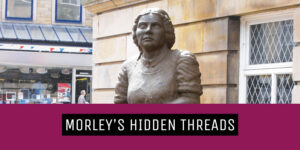
A reminder of the people behind this industry can be found in the statue of a Morley weaver, carved from Morley stone by sculptor Melanie Wilks in around 2007. Originally sited near the Town Hall, the statue has since been relocated to Scatcherd Park, where it continues to commemorate the generations whose labour sustained the town.
So next time you stroll along Queen Street or wander past Albion Street, spare a thought for the generations who worked these mills. Morley’s textile history is still quietly woven into the streets around you.
With thanks to Morley Archives for their invaluable help with this article.
For more on Morley’s history, visit: morleyarchives.org.uk